
Overview
Carnival Cruise Line is one of the world’s largest and most recognizable cruise brands, famous for pioneering the “Fun Ship” experience and making high value cruising accessible to a global audience. As an industry leader carrying millions of guests annually across North America, Europe, and beyond, Carnival continuously pairs its signature hospitality with world class operational management.
Business Context
Operating at an unprecedented global scale requires an unwavering commitment to maritime excellence, safety compliance, and fleet resilience. Carnival Cruise Line has consistently maintained a robust regulatory baseline, meeting and exceeding international maritime safety standards.
As Carnival continued to introduce larger, next generation vessels to its fleet, leadership recognized an opportunity to match their massive physical scaling with digital transformation. To achieve this, they sought to transition from traditional, transaction based assembly tracking to a highly coordinated, data driven intelligence network that optimizes crew workflows and elevates the mustering experience for guest and crew.
The Challenge
Maximizing Data Velocity and Crew Efficiency at Scale
Managing high volume guest flows across modern, multi deck vessels requires exceptional administrative coordination. While Carnival’s baseline safety systems consistently met all regulatory requirements, leadership sought to elevate their operational technology to match the capabilities of modern, next generation vessels.
To pioneer a new benchmark for fleet efficiency, Carnival identified key operational areas ripe for technological advancement:
- Accelerating Cross Station Synchronization: Traditional mustering frameworks relied on localized data capture that required sequential coordination between individual stations. Shaving down communication latency and eliminating manual reporting handoffs presented a clear opportunity to optimize fleet workflows.
- Optimizing Crew Interaction & UI/UX Design: Legacy interfaces required multi-step manual navigations, which increased the onboarding and training timelines for rotating crew members. Carnival sought a highly intuitive, consumer grade enterprise interface to maximize frontline productivity.
- Maximizing Hardware Duty Cycles: Standard mobile applications operating under continuous, high load operational periods naturally experience heavy battery drain. Carnival required an engineered software solution capable of maximizing mobile device power efficiency to eliminate mid-operation hardware maintenance and resource swapping.
The Solution
Introducing sMuster’s Connected Architecture
To achieve this digital evolution, Carnival Cruise Line partnered with SKO Systems to engineer and deploy sMuster, a purpose built, data driven operational platform built to master the velocity of modern cruise logistics.
SKO Systems engineered a scalable infrastructure upgrade that injected speed, resilience, and intelligence into Carnival’s onboard operations. By pairing an offline first data model with advanced power management algorithms, sMuster successfully unlocked:
- Rapid, friction free roll-calls and automated zone switching.
- Instantaneous, fleet wide data visibility for senior officers.
- Seamless operation across native mobile applications, specialized tablet interfaces, and a resilient, on vessel local server architecture.
The Results
Unlocking Massive Operational Wins
The deployment of sMuster transformed assembly operations into a masterclass of digital efficiency, delivering an exceptional return on investment (ROI) through substantial time and labor savings.
Comparative Summary
(Based on a standard 10 station asset model per voyage):
- Roll-Call Acceleration: ~60 minutes saved
- Automated Reporting & Sync: ~90 minutes saved
- Flow Switching & Dynamic Coordination: ~30 minutes saved
- Total Operational Time Saved Per Drill: ~0.5 to 1 Hours
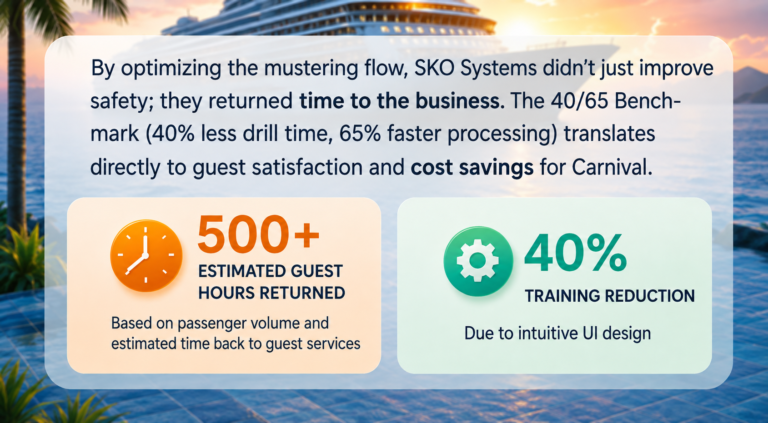
Crew Resource Impact: reallocated 500+ man hours per voyage (based on passenger volume and estimated time back to guest services) back to core guest services and primary hospitality workflows, significantly lowering operational friction and hardware maintenance overhead
Before & After Comparison Chart
|
Area |
Traditional Fleet Model (Before) |
Innovative sMuster Model (After) |
|
Data Visibility |
Asynchronous data updates across localized stations. |
Instantaneous, centralized real time leadership dashboards. |
|
Data Consistency |
Required post drill manual alignment and validation. |
99%+ automated data consistency across all active vessel zones. |
|
Audit Readiness |
Manual reporting compilation and retrospective logs. |
Fully searchable digital history tracking and instant export ready reports. |
|
Device Stability |
Standard mobile power consumption under continuous operational load. |
Advanced background process management, delivering a 25–30% improvement in device battery efficiency. |
|
Operational Flow |
Manual, sequential station transitions and high communication overhead. |
Automated, seamless flow switching across all shipboard networks. |
|
Data Reconciliation |
Traditional manual data consolidation requiring up to 2 hours. |
Fully automated reconciliation completed in under 15 minutes. |
|
Crew Execution |
High volume of manual interaction steps and a 30% longer training curve. |
40–45% reduction in screen interaction steps paired with a 40% faster training adaptation time. |
Future Outcome
The successful integration of sMuster marks a definitive milestone in Carnival Cruise Line’s digital transformation roadmap. What began as a drive to optimize standard fleet administrative routines has evolved into a strategic operational capability that serves as a point of immense pride for the organization and for SKO Systems.
By embracing an automated, highly resilient edge computing framework, Carnival has significantly enhanced data accuracy, minimized operational bottlenecks, and improved the overall mustering experience for passengers and crew alike. This collaborative milestone reconfirms Carnival Cruise Line’s position as a true pioneer in maritime innovation, proving that forward looking technology design builds an incredibly secure, efficient, and modern journey at sea.