
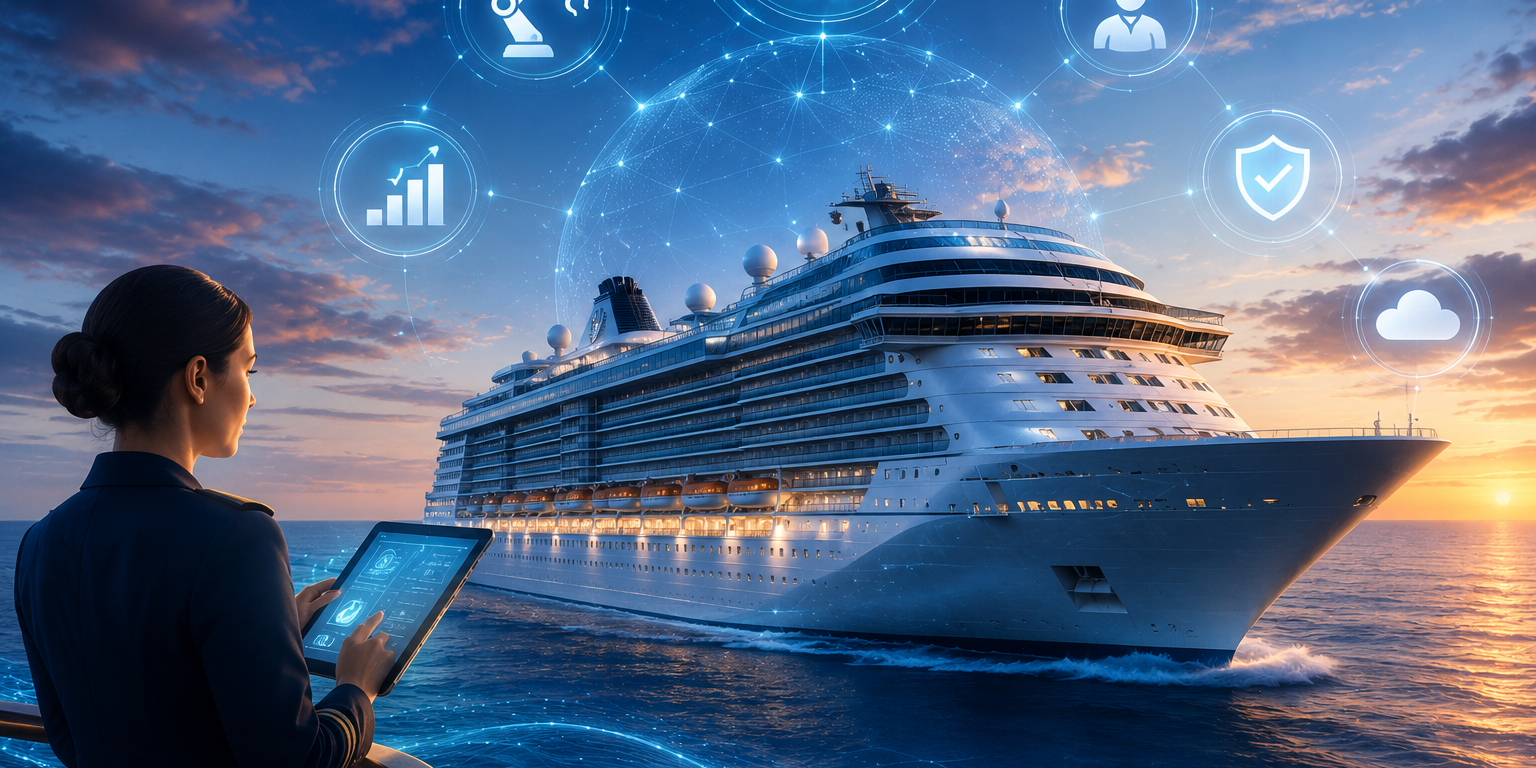
Redefining Cruise Line Operations and Guest Experience with AI
The global cruise industry is poised for a monumental digital transformation. As ships grow larger and passenger expectations for personalized, seamless travel increase, traditional operational models are reaching their limit. The solution lies in Artificial Intelligence (AI). By 2026, AI technologies will not just optimize, but fundamentally transform the cruise ecosystem, impacting everything from guest embarkation to back- of-house staff management.
SKO Systems delves into the six most impactful AI technologies that cruise lines must integrate now to stay competitive, efficient, and profitable in the near future.
Section 1: Core AI Technologies Driving Transformation
These below technologies represent the advanced, integrated solutions that will move cruise lines from basic automation to true intelligent operation by 2026.
Biometric AI for Guest Flow
Computer vision uses deep learning models to process visual data from cameras, enabling machines to “see” and interpret the world. In the cruise context, this shifts the paradigm of passenger movement and security.
- Technology Focus: Real-time facial recognition (FR) and object detection.
- Product Integration: Custom CV modules integrated with existing security camera systems and gangway portals.
Predictive Maintenance AI
Predictive Maintenance uses Machine Learning (ML) to analyse sensor data (vibration, temperature, pressure) from critical ship machinery, predicting failures before they occur. This eliminates costly emergency repairs and downtime.
- Technology Focus: Time-series analysis, anomaly detection, and deep neural networks for prediction.
- Product Integration: Cloud-based ML platforms ingesting data from IoT sensors across engines, HVAC, and galley equipment.
Generative AI for Hyper-Personalization
Beyond simple rule-based chatbots, Generative AI creates unique content, itineraries, and conversational responses tailored to the individual guest, dramatically improving service management.
- Technology Focus: Large Language Models (LLMs) and context-aware natural language processing (NLP).
- Product Integration: Guest-facing mobile apps and onboard service terminals powered by bespoke LLMs trained on ship data and guest history.
Advanced Inventory and Waste Optimization AI
This technology leverages AI to forecast food, beverage, and supply needs with unprecedented accuracy, minimizing waste (a major environmental and cost concern) and ensuring stock availability.
- Technology Focus: Deep learning forecasting models, including Recurrent Neural Networks (RNNs), analysing seasonality, passenger demographics, and consumption patterns.
- Product Integration: Integration with Point-of-Sale (POS) systems, supply chain management software, and galley inventory sensors.
Multi-Agent AI Systems for Resource Orchestration
This is the most advanced form of AI integration. Multiple, independent AI ‘agents’ (each managing a specific domain, e.g., cleaning schedules, room service, maintenance) communicate and collaborate to optimize the entire ship’s operations simultaneously.
- Technology Focus: Distributed AI, reinforcement learning, and centralized command-and-control frameworks.
- Product Integration: A central AI platform (the "Ship Brain") that receives inputs from all systems and autonomously adjusts operational parameters.
AI-Driven Revenue Management and Dynamic Pricing
Using ML to analyse real-time demand, competitor pricing, booking pace, and demographic sensitivity, this AI dynamically adjusts pricing for cabins, excursions, and onboard services to maximize yield.
- Technology Focus: Regression analysis, clustering algorithms, and real-time optimization engines.
- Product Integration: Direct integration with the central booking system and POS systems.
Section 2: Scope of Technological Advancement in Essential Operations
The immediate, high-impact application of these AI technologies lies in accelerating high-volume, repetitive, and time-critical operational bottlenecks.
Embarkation, Gangway Operations, and Debarkation
- Technology Focus: Regression analysis, clustering algorithms, and real-time optimization engines.
- Product Integration: Direct integration with the central booking system and POS systems.
The most visible pain points for guests are the queues and slow security checks. AI provides the essential solution.
Visitor Management and Security
(Manual/Basic Automation) |
|
|
Embarkation Check: Long lines, slow verification against manifests, human error. | Computer Vision (1): Biometric facial recognition at check-in kiosks and gangway portals completes identity and ticket verification in second. | Speed & Security: Eliminates bottlenecks; allows security staff to focus on genuine threats; enables “frictionless” check-in process. |
Baggage Screening: Human review of X-ray images, leading to fatigue and missed items. | Object Detection AI (1): AI automatically identifies prohibited items (e.g., weapons, explosives) with higher accuracy than humans, flagging only suspicious bags for manual check. | Efficiency: Accelerates baggage flow and enhances security integrity. |
Debarkation Logistics: Guests rush to specific decks; manual organization of customs documents. | Multi-Agent Orchestration (5): AI plans debarkation groups based on shore excursion times, flight schedules, and customs capacity, dynamically broadcasting real-time flow instructions to guests’ phones. | Guest Experience: Smooth, personalized departure flow and minimal waiting time. |
AI elevates ship security and visitor tracking from static guard posts to a real-time, comprehensive protection grid.
Use Case: Unauthorized Access Alert:
AI Technology: Computer Vision (1).
- Mechanism: CV cameras monitor restricted areas (e.g., engine room entrances, staff-only corridors). If an individual without the required biometric access clearance attempts entry, or if an item is left unattended (unsupervised object detection), the AI immediately alerts security personnel with location data and a live feed.
- Essentiality: Proactive threat mitigation and compliance with maritime security protocols.
Uniform Management and Logistics
For thousands of staff members, managing inventory, issuing, cleaning, and tracking uniforms is a vast logistical challenge.
Use Case: Smart Uniform Tracking:
- AI Technology: Advanced Inventory Optimization (4) combined with RFID tags.
- Mechanism: RFID-tagged uniforms are tracked as they move through laundry and storage. Inventory AI predicts uniform replacement rates based on wear-and-tear data and staff turnover, automatically generating procurement orders weeks in advance to avoid shortages.
- Essentiality: Guarantees brand consistency, reduces replacement costs due to loss, and ensures every staff member is presentable.
Room and Cruise Staff Service Management
Multi-Agent AI and Generative AI collaborate to optimize staff routing, reduce response times, and elevate the quality of service interactions.
Use Case: Dynamic Staff Routing:
- AI Technology: Multi-Agent AI (5).
- Mechanism: The “Staff Agent” tracks the real-time location and current task load of all housekeeping and room service staff. When a guest submits a request (e.g., “extra towels”), the Staff Agent immediately routes the request to the nearest and least-busy appropriate staff member, minimizing travel time and ensuring a guaranteed service window.
- Essentiality: Dramatically improved service speed, higher guest satisfaction scores, and maximized staff efficiency (less walking, more serving).
Section 3: AI Integration: Advanced Requirements and Implementation
The transition to a AI-driven cruise line requires a structured, multi-phase implementation focused on data readiness and scalable infrastructure.
Phase 1: Data Readiness and Infrastructure Setup (Low-Cost Focus)
AI models are only as good as the data they consume. This phase focuses on preparation.
- Requirement: Standardizing data formats (sensor readings, guest logs, transaction history) into a unified, secure data lake.
- Procedure:
- Audit: Identify all data sources (POS, PMS, IoT, Booking).
- Harmonize: Implement ETL (Extract, Transform, Load) pipelines to clean and structure data.
- Foundation: Deploy a cloud-based data lake (e.g., Google Cloud, Azure) to centralize storage.
- Cost Involved (Low to Medium): Primarily data governance, cloud subscription fees, and integration services.
Phase 2: Pilot Deployment and Model Training (Medium-Cost Focus)
Focusing on isolated, high-value systems like Predictive Maintenance (Predictive Maintenance).
- Requirement: Deploying initial AI models in a non-critical environment to establish baseline performance.
- Procedure:
- IoT Deployment: Install specific vibration and temperature sensors on 3- 5 critical pieces of machinery.
- Model Training: Train the Predictive Maintenance model (2) on historical failure data and live sensor feeds.
- Validation: Run the Predictive Maintenance model alongside the current manual maintenance schedule for six months to prove its accuracy.
- Cost Involved (Medium): IoT hardware (sensors), data science team hours for model training and iteration.
Phase 3: Cross-System Integration and Multi-Agent Deployment (High-Cost Focus)
Connecting the various AI modules to create a holistic, self-optimizing ship.
- Requirement: Creating the centralized platform for agents to communicate and deploying consumer-facing Generative AI.
- Procedure:
- API Layer: Build robust APIs allowing the Inventory AI (4) to talk to the Dynamic Pricing AI (6) and the Staff Agent (5).
- Generative AI Rollout: Deploy the LLM for guest interaction, ensuring security and guardrails are in place to prevent misinformation.
- Real-Time Dashboard: Create a single, integrated operations dashboard for human oversight of the autonomous systems.
- Cost Involved (High): Specialized AI platform development, licensing for advanced LLMs, and intensive system integration and security testing.
sMuster leverages multiple identification technologies to ensure the fastest possible check-in rate at muster stations:
Section 4: Use Case, Cost Analysis, and Essentiality
Integration with Identification Technologies
The implementation of these technologies, while initially costly, yields exponential returns in efficiency and customer lifetime value.
Use Case Deep Dive: Proactive Guest Service via Generative AI (3)
- Scenario: A guest, Sarah, is looking at dining options on the ship’s mobile app. She previously mentioned a peanut allergy during booking and has consistently ordered vegetarian meals.
AI Action:
- LLM (3): The Generative AI model monitors her behaviour. Instead of showing all 10 restaurants, it uses her history to proactively suggest the three best-rated vegetarian-friendly options with live availability.
- Personalized Content: Sarah asks, “What’s the best show for a solo-traveller tonight?” The AI, knowing her demographic and past interaction patterns (she preferred a quiet evening over a party), suggests a specialized jazz club and automatically offers to reserve a table close to the band, creating a personalized, unprompted upsell opportunity.
- Essentiality: Moves from responsive service (answering a question) to proactive, anticipatory service. This is the key differentiator for premium travel in 2026.
Interpretation of Financial Investment
Implementing the six AI technologies involves significant Capex (Capital Expenditure) in the first year, but the OpEx (Operational Expenditure) savings and revenue gains create a massive Return on Investment (ROI).
Step 1: Event Initiation (Bridge)
The Safety Officer initiates the Muster Drill event in the sMuster web console. This action instantly:
- Broadcasts the drill status to all crew
- Activates the real-time tracking dashboard for the Bridge
- Locks the passenger manifest data for accountability
Cost Category | Breakdown | Estimated Impact on Initial Investment |
Data Acquisition | Cloud Hosting, data lake set-up, ETL tools, API gateway Creation | 30% |
AI Model Development & Training | Data scientists/ researchers salaries, model licensing, specialized training data acquisitions | 40% |
Hardware & IoT Deployment | Biometric scanners, security cameras, engine. HVAC systems | 15% |
System Integration & Testing | Ensuring seamless communication between all operational, booking and guest systems | 15% |
ROI vs. Time
Projected ROI and Cumulative Savings Over 3 Years Post-AI Implementation
Key Data Points:
- Year 1: High Capex (Initial Investment) balanced by initial OpEx savings (e.g., reduction in maintenance costs, reduction in waste). ROI is positive but modest.
- Year 2: Capex stabilizes, OpEx savings accelerate ( reduction in maintenance/waste, increase in dynamic pricing yield). ROI shows significant acceleration.
- Year 3: Full operational efficiency achieved ( OpEx reduction, yield increase). The cumulative net profit demonstrates the long-term essentiality of the investment.
Conclusion: The Essentiality of Intelligence on Cruise
By the end of 2027, AI will cease to be a competitive advantage and become a fundamental operational necessity for the cruise industry. The six technologies outlined—from Computer Vision for frictionless guest flow to Multi-Agent Systems for total resource orchestration—are the backbone of the next generation of cruising.
The implementation procedure, while requiring substantial investment in data infrastructure and specialized talent, guarantees:
The accumulated data allows the cruise line to:
- Enhanced Profitability: Via Predictive Maintenance (reduced downtime) and Dynamic Pricing (optimized yield).
- Superior Guest Loyalty: Via Generative AI hyper-personalization and rapid service management.
- Ironclad Security & Compliance: Via Computer Vision monitoring and real- time security alerts.
SKO Systems specializes in bridging the gap between legacy cruise operational technology and the inevitable AI-driven future, ensuring voyage into 2026.
Schedule a Demo

Phalguna is currently working as a Sr. Tech. Content Writer with SKO Systems. He is passionate about creating clear, user-focused technical content and has expertise in end-user documentation, release notes, HTML, WordPress, and content strategy. Through his articles, he brings a practical perspective that makes complex information easier for readers to understand and apply.
I have recommended your blog to all of my friends and family Your words have the power to change lives and I want others to experience that as well